
On this page
How seamless gutters are made
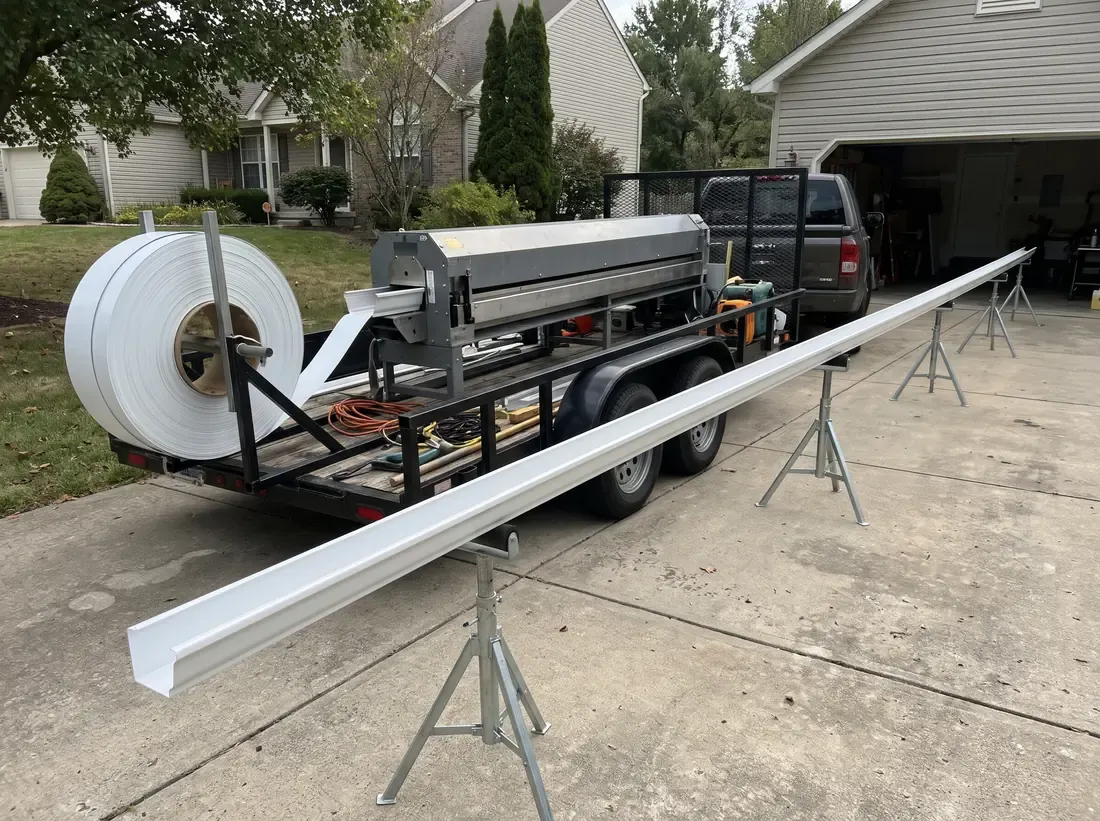
The contractor brings a gutter machine on a truck or trailer. Flat aluminum coil feeds in one end, and rollers bend it into a K-style or half-round profile. The crew measures each eave, runs out a piece to that length, and carries it up. The only joints are where two runs meet at a corner, at the end caps, and where outlets are cut for the downspouts.
Why fewer joints matter here
Sectional gutters come in 10-foot lengths joined with connectors and sealant. On a 180-foot house that is well over a dozen extra joints. Sealant in a south Louisiana gutter has a hard life: summer sun on dark metal, months of humidity, and storms that fill the trough to the brim. When a joint starts to weep, it drips onto the same patch of fascia every time it rains, and Baton Rouge averages about 62 inches a year. Over a few seasons that is how fascia rots from the back, and wet wood is exactly what Formosan termites look for.
Seamless gutters do not end that risk, but they remove most of the places where it starts.
What to specify
| Item | Good practice | Why |
|---|---|---|
| Profile | 5-inch or 6-inch K-style; half-round on older houses | K-style carries more water for its width |
| Coil thickness | .027 inch minimum, .032 on long or high runs | Thicker coil resists dents from limbs and ladders |
| Hangers | Screwed hidden hangers about every 2 feet | Hold a full trough and resist wind |
| Pitch | About 1/4 inch per 10 feet | Keeps water moving so debris does not settle |
| Corners | Mitered, riveted, sealed in dry weather | The main leak points |
| Downspouts | 2x3 or 3x4, strapped at every joint | 3x4 clogs less with oak leaves |
Seamless on Baton Rouge houses
Brick ranches in Broadmoor, Sherwood Forest and Goodwood usually take 5-inch K-style. Two-story homes in Shenandoah, Highland Road and the newer subdivisions in Prairieville and St. George often have big hip roofs with valleys that suit 6-inch. Bungalows and cottages in the Garden District and Spanish Town may look better in seamless half-round; see half-round gutters.
Common mistakes to avoid
- Choosing the thinnest coil to save money, then watching it dent under a falling limb.
- Accepting spikes or widely spaced hangers on a house that will see hurricane wind.
- Letting the crew seal corners on a damp day; sealant needs dry metal to bond.
- Forgetting the drip edge, so water still runs behind the new gutter.
- Connecting new downspouts to an old buried drain line without testing it.
Seamless or sectional?
Sectional gutters from a store are cheaper and can be put up by a handy owner on a shed or garage. On a house in this climate, seamless is almost always the better buy. See seamless vs sectional.
In Baton Rouge and the Capital Region
Seamless is now the norm on most Baton Rouge houses, from mid-century brick ranches in Broadmoor and Sherwood Forest to new two-story homes in St. George, Prairieville and Zachary. Sectional gutters still turn up on older homes that were never upgraded, garages and do-it-yourself additions.
When to do it
Fall through early spring is the easiest window, ahead of the oak drop and hurricane season. Summer work is fine, but afternoon storms push crews into the mornings.
What to ask before you agree
Ask for the coil thickness and hanger spacing in writing, how many downspouts are included and at what size, whether drip edge and fascia repair are priced, and whether drain lines will be tested.
How a seamless installation runs
- The contractor measures each eave, counts corners and outlets, and checks the fascia and drip edge.
- You get a written quote listing gutter size, coil thickness, color, hanger type and spacing, downspout size and number, and any fascia work.
- On the day, old gutters come down and soft fascia is replaced.
- The machine forms each run to length on site.
- Runs are hung on screwed hidden hangers at the agreed pitch, corners are mitered, riveted and sealed, and outlets are cut.
- Downspouts are strapped, connected to drain lines or extensions, and every run is water-tested.
- Old material is hauled away, and you get the warranty in writing.
Seamless and Baton Rouge storms
A seamless run's weak points in hurricane country are its fastenings. Hidden hangers screwed through the gutter into sound fascia, about every 2 feet, hold far better against wind lifting from below than spikes every 3 or 4 feet. Strapping each downspout at every joint keeps it on the wall. Those details cost little at installation and matter a great deal in August and September.